Tracing Payment Pathways to Record-Breaking Wins in Live Mobile Table Simulations
Devon Vogel · Aug 19, 2026

Tracing Payment Pathways to Record-Breaking Wins in Live Mobile Table Simulations
Live mobile table simulations have produced documented record wins in recent years, and payment pathway tracing has become a central element in verifying those outcomes while maintaining system integrity across platforms. Operators rely on layered transaction monitoring that follows funds from deposit initiation through game resolution, and data from multiple jurisdictions shows how these systems handle high-volume mobile traffic without interruption.
Payment Infrastructure in Mobile Table Environments
Modern mobile table simulations integrate real-time payment gateways that connect directly to banking networks, digital wallets, and prepaid card processors, and this architecture allows simultaneous handling of thousands of micro-transactions per minute. Researchers at academic institutions have examined how these gateways embed unique identifiers at each step, creating an auditable trail that regulators can review when large payouts occur. The process begins when a user authorizes a deposit on their device, after which the funds route through encrypted channels to the operator’s segregated account before being credited to the simulation interface.
Security protocols require multi-factor authentication and device fingerprinting at the point of entry, and these measures help distinguish legitimate player activity from automated attempts that might otherwise distort win records. In practice, the pathway continues as game outcomes are calculated on remote servers, with win notifications triggering immediate balance updates that remain linked to the original transaction ID throughout the session.
Regulatory Oversight and Transaction Verification
Government agencies in several regions mandate continuous monitoring of payment flows within live table simulations, and the Nevada Gaming Control Board has published guidelines requiring operators to retain detailed logs for a minimum of five years. Similar requirements appear in Canadian provincial frameworks, where the Alcohol and Gaming Commission of Ontario oversees iGaming platforms and demands periodic audits that cross-reference payment records against reported wins. These standards ensure that record-breaking outcomes can be reconstructed step by step, confirming that no external manipulation occurred during fund movement or result generation.
Industry reports indicate that August 2026 will mark the implementation of updated data-sharing protocols between operators and oversight bodies in multiple jurisdictions, and these changes aim to standardize how payment identifiers travel alongside game logs. The new framework builds on existing systems by adding timestamp granularity that captures every balance adjustment down to the millisecond, reducing the window for discrepancies during high-stakes sessions.
Technology Supporting Traceability
Blockchain-based ledgers and advanced analytics platforms now supplement traditional databases in tracking payment movement within mobile table environments, and several operators have adopted distributed ledger technology to create immutable records of each deposit and withdrawal. Studies conducted by research groups affiliated with European universities have demonstrated that combining these ledgers with machine-learning anomaly detection improves the speed at which unusual win patterns are flagged for further review. The resulting datasets allow analysts to map complete pathways from initial funding source through final payout, even when players switch devices or payment methods mid-session.
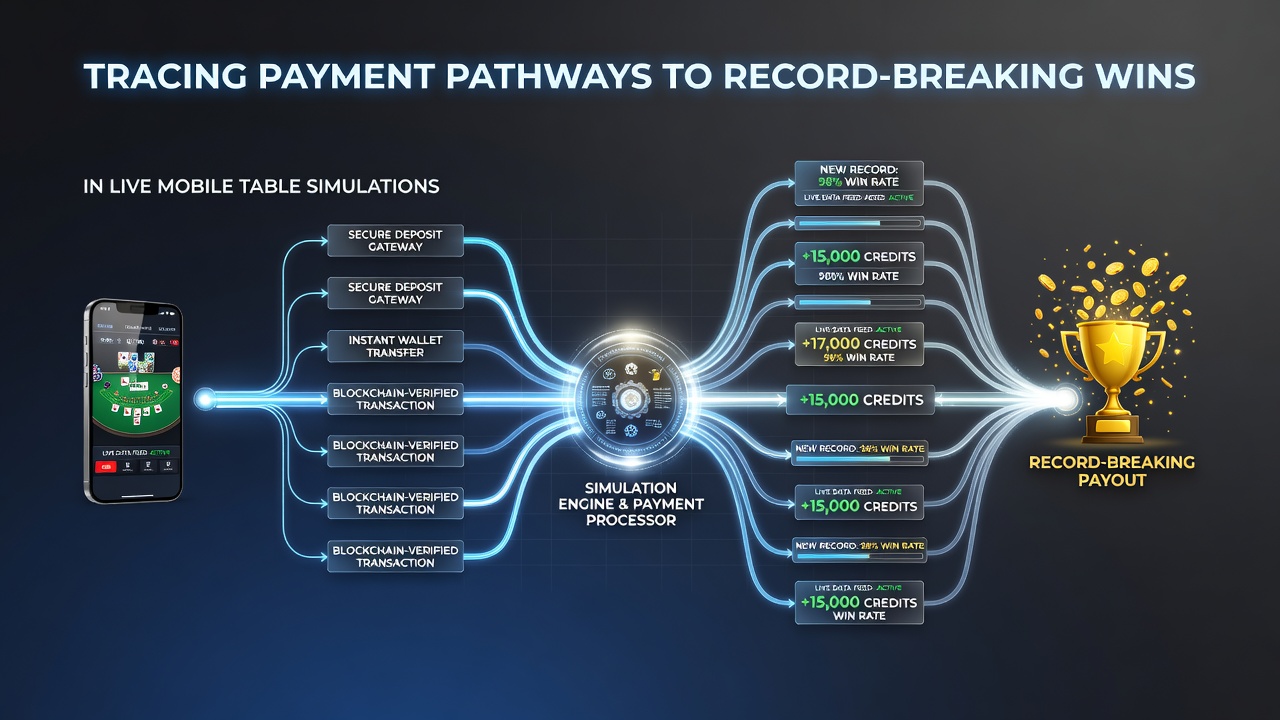
Real-time reconciliation engines compare incoming payment confirmations against game server outputs, and any mismatch immediately suspends further activity on the affected account until manual verification completes. Observers note that this level of integration has proven particularly valuable during periods of rapid growth in mobile participation, when transaction volumes spike and the risk of processing errors increases accordingly.
Documented Record Wins and Pathway Analysis
Publicly reported cases from 2024 and 2025 illustrate how traced payments supported validation of major wins in mobile blackjack and roulette simulations, and one instance involved a multi-step deposit sequence that originated from a regional banking app before reaching the simulation platform. Regulators reviewed the complete chain, including intermediate wallet transfers, and confirmed that all steps complied with jurisdictional limits on single-session deposits. Such reviews typically conclude within days when the payment identifiers align with the operator’s internal logs, allowing winners to receive funds without extended delays.
Additional examples from Australian markets show similar patterns, where the Australian Communications and Media Authority has required operators to submit pathway summaries alongside payout reports for any win exceeding a defined threshold. These submissions include source IP data, device identifiers, and timestamped payment authorizations, creating a comprehensive picture that external auditors can evaluate independently.
Conclusion
Payment pathway tracing in live mobile table simulations continues to evolve alongside regulatory expectations and technological capabilities, and the systems in place ensure that record-breaking outcomes remain verifiable through documented financial sequences. As platforms prepare for enhanced data protocols scheduled for August 2026, the emphasis on precise tracking supports both operational efficiency and compliance across regions. Continued refinement of these processes will likely depend on collaboration between operators, technology providers, and oversight bodies working from consistent standards.